RIEFENSTAHL
🎞️

While we all know the 12 days of Christmas officially ends on 6th January - the hard-stop for tinsel on trees and eating of leftovers and quaffing of thimbles of sherry first thing in the morning - that count only makes any sense whatsoever if we persist in the delusion that Christmas begins on Christmas Day. In reality, we have had chocolate Santas on our supermarket shelves since the moment the Easter eggs were removed, so the 21st century is giving us a good 250 days of Christmas by my rough estimate, some 238 more than the lyrical and entirely sufficient 12. And, all things being relative, the overeating and over-indulging revving up in the name of Jesus over those 250 days is bound to have an impact on our tastebuds, making what might normally be saccharine and unpalatably sweet fare feel kinda middle of the road and more digestible in late December, nigh savoury. To boot, I watched THE LIFE OF CHUCK, an entirely over-egged, candy-coloured melodrama I’d avoided on the basis it was capable of sending me into a diabetic coma if encountered in mid-February, say, and… I kinda liked it and was touched by the central conceit that we all contain entire universes within us, multitudes (although even by Yuletide measures I thought the dancing was truly terrible, soulless, even if overrated Tom Hiddleston tells us he spent months and months in rehearsals with choreographer Mandy Moore…). I even cried a bit. And that’s not the worst of it: on New Year’s Eve I took myself on a solo trip to rewatch SENTIMENTAL VALUE in the cinema before returning home and putting THE GREATEST SHOWMAN on the big screen and timing it to hear the lyrics to This Is Me as the clock struck midnight so that I could sing along while catching a glimpse of the fireworks rising above Alexandra Palace from my bedroom window: “Look out 'cause here I come / And I'm marching on to the beat I drum / I’m not scared to be seen / I make no apologies / This is me.” Yes, that really happened, ffs.
Enough already. Let’s call it: Christmas is OVER.
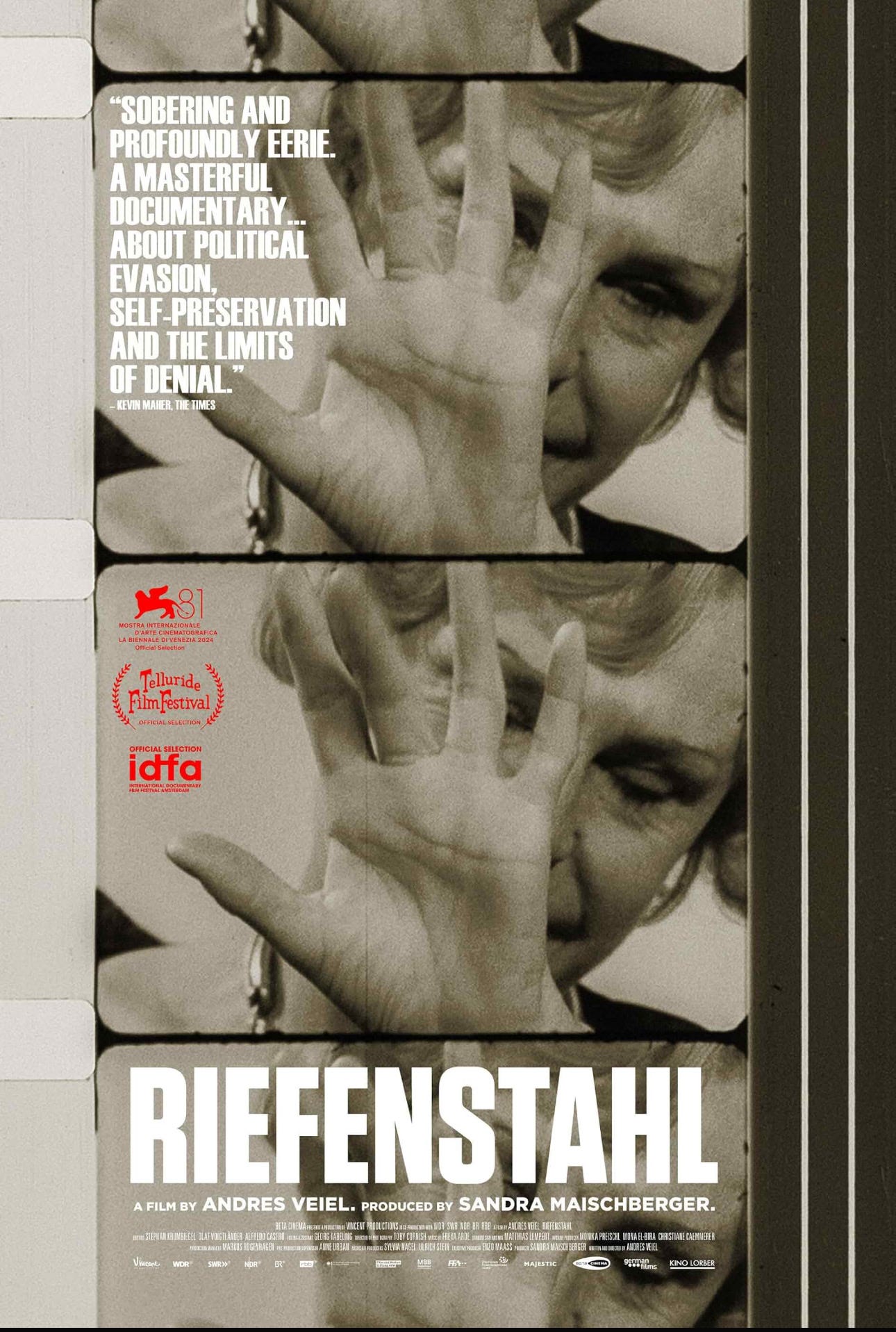
Today is the first working day of the new year and it is time for us to get back to the bitter realities of our forsaken world, the dismal deficit in political leadership and the devastation, inequality and warmongering of late-stage capitalism. Searching for the cinematic equivalent of an insulin shot to recover from holiday hypoglycaemia, I landed on Andrew Veiel’s RIEFENSTAHL. Ermmmmm. Something of an over-correction, perhaps, but if there is one thing I can tell you about RIEFENSTAHL, it’s that it is definitely NOT a Christmas movie.
If there were a list of the key philosophical questions we are grappling with so far this century, one of them is surely whether or not we can or should separate the art from the artist. The #MeToo movement brought the debate to the fore, most successfully explored by Claire Dederer in her book Monsters, imo, and our inconsistent and injudicious ‘cancel culture’ has cost us some of the greats (can we have Dustin Hoffman back, please? And Bill Murray?) while other transgressors benefit from apparent immunity from any consequences whatsoever (and some benefit from literal immunity… President Trump, for “official” acts if not those deemed “unofficial”… and so he is “officially” a rapist, I guess?).
Leni Riefenstahl was a so-so film actress before she tried her hand at directing in 1932 with THE BLUE LIGHT and caught the eye of political up-and-comer Adolf Hitler, recruited by him to make TRIUMPH OF THE WILL and OLYMPIA, both Third Reich propaganda films, the first shot at the Nazi Political Rally at Nuremberg in 1934 and the latter at the Berlin Olympics in 1936. As such, she is arguably the most highly qualified artist to be the subject of the above referenced debate provided you don’t challenge the assumptions that (i) she was a phenomenal filmmaker, and I’d aver she absolutely was, and (ii) she was a Nazi.
As regards (ii), it is true that Riefenstahl was arrested in 1945 (by Budd Schulberg! Yes, the writer of What Makes Sammy Run? was the designated officer charged with arresting her at her home in Kitzbuhel in the aftermath of the war…. 🤯) and ultimately found to be a Mitlaufer, literally translated as a “fellow traveller” and what we might call a sympathiser, rather than a card-carrying Nazi per se, but I don’t believe it. Her pleas of ignorance and naiveté just don’t ring true to me. Veiel’s film distinguishes itself from Ray Muller’s seminal precedent, THE WONDERFUL HORRIBLE LIFE OF LENI RIEFENSTAHL, by focusing on his access to Riefenstahl’s vast personal archive, the carefully curated story she wanted to tell of herself and for which she wanted to be remembered. She was not only a director, but also a more than proficient editor, a supreme crafter of stories and manipulator of an audience’s emotions, and her archive tells no less a carefully woven tale than THE BLUE LIGHTS or, indeed, TRIUMPH OF THE WILL.
If we were to take Riefenstahl’s story as told across the 700 boxes of her archive, we would have to believe the artist to be entirely separate from the context in which he or she operates -
“Politics is the opposite of everything that has fulfilled and fascinated me throughout my life.”
“What is the opposite of politics?”
“Art. It’s art, for me. Exploring things where you have to penetrate to a deeper level. If you feel things intensely as an artist, and I was born that way, you love your life so ardently, so intensely, so passionately, that there’s no room for interest in real-world issues.”
I imagine this oft-practiced argument might go some distance when it comes to explaining an artist’s poor personal hygiene habits or his failure to file his taxes on time or even the trail of heartbroken lovers he has left behind him… but turning a creatively blind eye to Hitler? To the Holocaust? To World War II? Methinks not. The evidence contradicting Riefenstahl’s “I’m only an artist!” defence mounts during the course of the film, including her chummy friendship with the Fuhrer himself, her 1944 marriage to SS Officer Peter Jacob, and, horrifyingly, irrefutable evidence that she cast Roma children from internment camps as extras in her 1944 production of TIEFLAND, all of whom were ultimately murdered at Auschwitz. Those innocent children were gassed in an all-too real world, and one which has been excised from Riefenstahl’s not-truly-real-at-all personal archive.
Veiel’s film is a lesson in trying (and ultimately failing) to control the narrative. Riefenstahl spent more than 10 years writing her memoirs, turning to Nazi architect Albert Speer for publishing advice after his own autobiography garnered him a pretty penny and some degree of rehabilitation (and who has an air of a 60s-era Gregory Peck about him, right? Note to self: handsome Gregory Peck-types who are also accomplished architects can still be a very, very, very poor choice of second husband…), doing her bestest to craft a tale of admirable artistic pursuit above all else, including politics… including people…. What a loada shite, eh? And what a timely and much-needed lesson for us.
For my part, I believe Leni Riefenstahl to have been both a phenomenal filmmaker and a Nazi. As regards the latter, the trials at Nuremberg failed to hold her fully to account and so, too, did karma (she lived to the ripe old age of 101 and most of it with a lover forty years her junior, ffs! And here I am with literally no blood on my hands, a cancer diagnosis and stuck watching shit films alone in bed on NYE… why is life so fucking unfair?!), and so the reframing of her narrative by filmmakers Ray Muller and now Andres Veiel is welcome restorative (and poetic…) justice.
RIEFENSTAHL will leave a sour taste in your mouth, for sure, but after the super-sweetness of all that saccharine holiday-fare, it’s a bitter but necessary pill to swallow as we advance into 2026 and the all-too-real-world issues we face, not least fascism on the rise and our societal, cultural, moral need for artists to tell stories that will fight it, not feed it. ⭐️⭐️⭐️⭐️